More than 90% of startups fail. That number is striking, but what’s even more important is why: most teams don’t fail because they lack talent or money. They fail because they build something nobody wants.
Eight developers spent 18 months and nearly $600,000 building a project management app full of features. It included a Gantt chart, time tracking, client portals, 14 tool integrations, and a video call system. On launch day, only 43 people signed up. Two weeks later, most had stopped using it. The feedback was clear: “It’s too complicated. We just needed a simple task board.”
This kind of situation happens to hundreds of companies every year. Rather than focusing on hiring more people or spending more on marketing, teams should rethink how they build software. The solution is to start with an MVP.
Key Takeaways
- An MVP is the smallest version of a product that tests your core hypothesis with real users.
- The goal is not to ship a half-finished product. The goal is to learn as fast as possible with as little waste as possible.
- There are multiple types of MVPs: concierge, Wizard of Oz, landing page, piecemeal, and single-feature. The right type depends on your biggest unanswered question.
- Always define your success metrics before you launch, not after.
- Talk to real users early and often. Their behavior will teach you more than any internal planning session.
- The MVP is not the finish line. It is the starting point of a learning loop that never really ends.
What Is an MVP?
MVP stands for Minimum Viable Product. The term was coined by product consultant Frank Robinson and later spread widely by Eric Ries in his book The Lean Startup.
A simple definition: an MVP is the smallest version of a product that delivers real value to real users and lets you learn something useful in return.
Every word in that sentence matters.
- Smallest means you are not building everything on your list. You are building as little as possible while still creating something worth using.
- Real value means it solves a problem. It is not just a mockup or demo; it actually works.
- Real users mean people outside your company, people who have no reason to be nice to you.
- Learn something means you have a specific question you are trying to answer, and the product helps you answer it.
Let’s clear up one thing: minimum does not mean low quality. It means the product has a narrow scope. A user’s first experience still needs to feel solid and trustworthy. If your MVP crashes, confuses, or frustrates people, you will not learn anything useful about your idea.
The MVP mindset starts with one key question before building anything: what is the riskiest assumption in this idea, and how can I test it as cheaply as possible?
Every product idea rests on assumptions. “People will pay for this.” “Users will understand how to use it.” “This problem is painful enough that people will change their behavior.” An MVP is how you find out if those assumptions are true before you bet your entire runway on them.
MVP vs. Prototype vs. PoC: What’s the Difference?
These three terms get mixed up constantly, leading to poor decisions. Here is how they differ.

A prototype is an internal tool used to test a design or technical approach. It might be clickable wireframes in Figma, or a rough working model of a technical concept. Prototypes are usually shown to a small internal group or a handful of hand-picked users. They are not shipped to the public, and they are not expected to deliver real value.
A Proof of Concept (PoC) answers the question:
“Can we build this?”
It is about technical feasibility. Can the algorithm process data fast enough? Can the hardware handle the load? A PoC is an engineering exercise, not a market test.
An MVP answers a different question:
“Should we build this?”
It goes out to real users, and it is designed to test whether the market actually wants what you are building. An MVP can generate real sign-ups, real revenue, and real feedback from strangers who found it on their own.
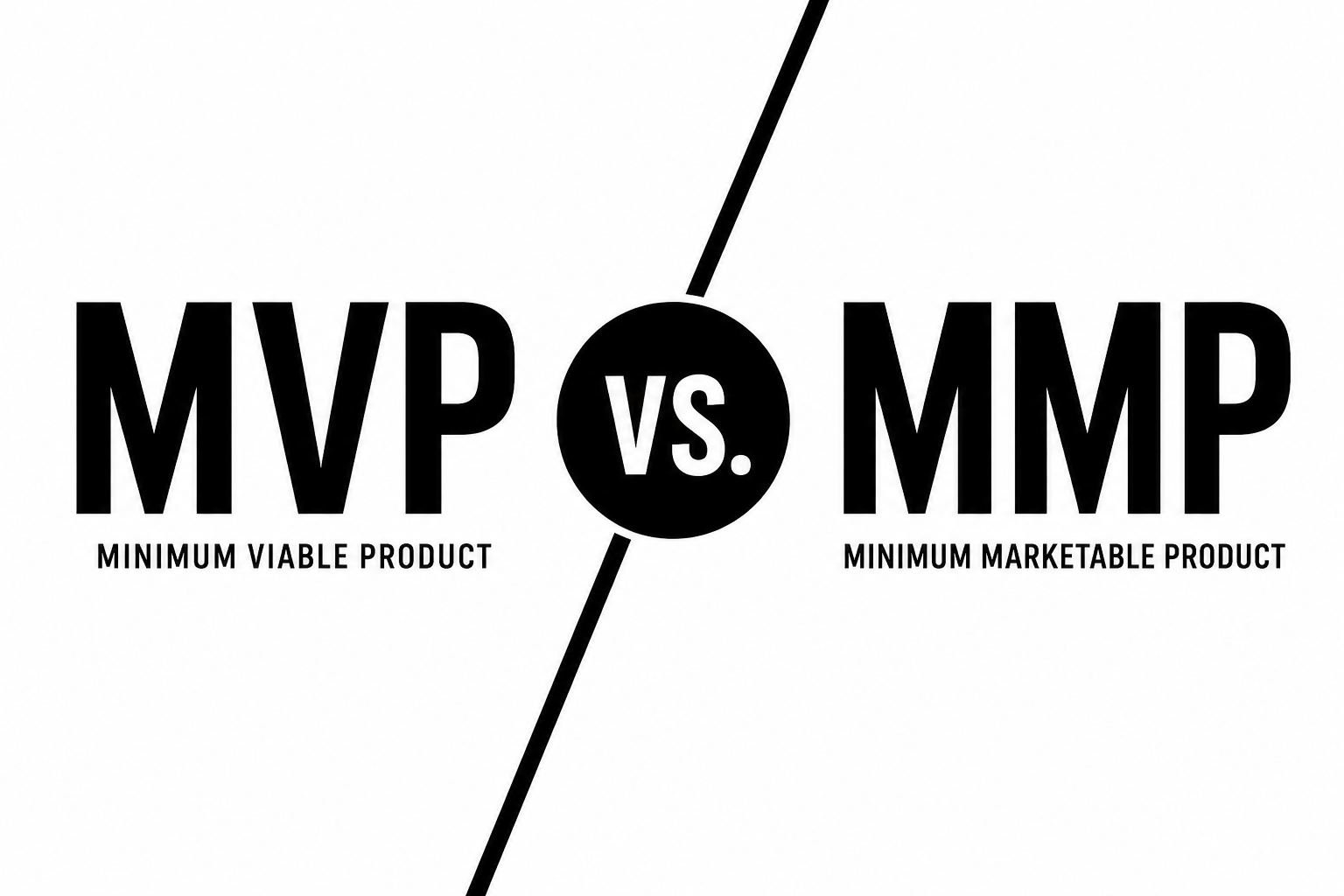
There is also a term called MMP (Minimum Marketable Product), which is the smallest product you can sell commercially at scale. An MVP may come before an MMP. You might run an MVP for 60 days, learn what your users need most, then launch an MMP that is slightly more complete and ready for a broader audience.
You can think of these as steps: PoC proves the technology works. The prototype shows what it might look like. The MVP tests if real people care. The MMP is ready to sell.
Why MVP Matters in Software Development?
Building a full product without validation is like printing 10,000 copies of a book before anyone has read a chapter. If readers dislike the ending, you cannot take those copies back.
Here is why the MVP approach has become standard practice across startups, agencies, and even large product teams inside corporations.
It cuts risk. The sooner you learn your idea doesn’t work, the easier it is to change direction. A wrong turn after two weeks of MVP costs little; after two years of full development, it’s everything.
It saves time and money. When you build only what users need most, you avoid spending engineering hours on features that will never get used. Feature bloat is one of the most common product killers. Teams build what sounds good in a meeting, rather than what users actually open the app for.
It gives you real data. Surveys, focus groups, and user interviews are helpful, but they are not the same as watching someone actually use your product. People say one thing and do another. An MVP puts your product in front of real users and lets their behavior tell you the truth. Click rates, session lengths, return visits, and churn tell a more honest story than any questionnaire.
It builds credibility. If you are raising money or pitching to stakeholders, a working MVP with 500 active users is worth more than a 40-slide deck. It shows that people want the thing and that your team can actually ship it.
Types of MVPs
There is no single template for an MVP. The right type depends on what you are trying to learn and your biggest uncertainty.
1. The Concierge MVP
A concierge MVP means you deliver the service manually before building technology to automate it. The product “works,” but you are doing the work by hand behind the scenes.
This is great for testing whether people actually want the service before you spend any time on backend infrastructure.
- A well-known example: the founders of Airbnb did not build a platform first. They rented out air mattresses in their own apartment during a design conference in San Francisco. They answered questions directly, managed the bookings by hand, and learned what guests and hosts actually cared about. The technology came later.
2. The Wizard of Oz MVP
Similar to the concierge approach, but users think they are interacting with a real automated product. Behind the curtain, a human is doing the work.
Zappos, the online shoe retailer, used this approach early on. Founder Nick Swinmurn did not build a warehouse or negotiate with shoe brands. He took photos of shoes from local stores, posted them on a website, and when someone ordered, he bought the shoes at the store and shipped them himself. He was testing one thing: whether people would buy shoes online. They would.
3. The Landing Page (Smoke Test) MVP
Build a page that describes your product, explains the value, and asks visitors to sign up, pre-order, or join a waitlist. No working product required.
Buffer, the social media scheduling tool, famously started this way. Founder Joel Gascoigne set up a two-page website. The first page explained the product. The second page displayed pricing plans and asked for an email address. People who reached the pricing page received a message saying the product was not ready yet and asking whether they wanted to be notified at launch. Hundreds of people said yes. That was enough validation to keep building.
4. The Piecemeal MVP
Stitch together existing tools, no-code platforms, and third-party services to simulate the product experience. No custom code required.
If you want to test whether a marketplace for freelance dog trainers would work, you could run the whole thing on Airtable, Zapier, Stripe, and a Carrd landing page. Users experience something that feels like a product. You learn whether they complete the flow and pay. Only after you have validated demand do you invest in custom development.
5. The Single-Feature MVP
Strip your idea down to its one most important feature, and build only that. Instagram launched with one core experience: take a photo, apply a filter, share it. No DMs, no Reels, no Stories, no ads. Just filtered photo sharing. That was enough. They got 25,000 users on launch day and hit 1 million users within two months.
The temptation is always to add more before launch. The discipline of the single-feature MVP is resisting that temptation.
How to Build an MVP Step by Step?
Step 1: Identify the Core Problem
Start by being specific about the problem you are solving and who you are solving it for. Vague problems lead to vague products.
Write a one-sentence problem statement: “[Target user] struggles with [specific pain point] because [root cause].”
Before you write a single line of code, confirm that real people actually experience this problem. Talk to 10 to 20 potential users. Ask them to describe the problem in their own words. Ask how they handle it today. Ask what they have already tried. If you cannot find people who experience the problem, you do not have a product.
Step 2: Define Your Core Value Proposition
What specific value does your solution deliver, and how is it different from what already exists? A useful format: “For (user), (product name) solves (problem) by (key mechanism), unlike (existing alternative).”
Be honest about the competition. If someone is already solving this problem well, your MVP needs to make clear why yours is better, faster, or more affordable.
Step 3: Map User Stories and Prioritize
List every feature and piece of functionality a user might ever want. Get it all out on paper. Then apply the MoSCoW method:
- Must have: Without this, the core product does not work.
- Should have: Valuable, but the MVP works without it.
- Could have: Nice to have one day, not now.
- Will not have: Out of scope entirely.
Only must-haves go into the MVP. For every feature you are tempted to include, ask: “If we cut this, does the core value disappear?” If the answer is no, cut it.
Step 4: Choose Your MVP Type
Match the type of MVP to your biggest unanswered question:
- Not sure if people want this? Use a landing page MVP to test demand before building anything.
- Not sure if people will understand how to use it? Use a concierge MVP to guide early users through the experience manually.
- Not sure if the technology is feasible? Build a PoC first, then move to an MVP once the technical risk is lower.
Step 5: Build Quickly, But Not Carelessly
Speed matters. An MVP that takes two years to build has already failed the “minimum” part of the definition. Use no-code or low-code tools where you can: Webflow for landing pages, Bubble for web apps, Glide for mobile apps, and Zapier to wire things together. Reserve custom engineering for the parts that genuinely cannot be done any other way.
Set a hard time limit. A healthy MVP sprint is 4 to 8 weeks for most software products. If you are still building at week 12, you are scope-creeping.
One thing not to cut corners on: the core user experience. The one thing your MVP does, it needs to do well. First impressions determine whether users come back or disappear.
Step 6: Define Success Metrics Before You Launch
This step is skipped constantly, and it is the most important one. Before you show your MVP to a single user, write down what success looks like. Specific numbers. Specific behaviors.
Examples:
- 30% of users who sign up will complete onboarding within 24 hours.
- At least 15% of users will return to the product within 7 days.
- 10 users out of 100 will upgrade to a paid plan within 30 days.
Without pre-defined metrics, you will rationalize any result as a win. “Well, the numbers were low, but the users who did engage really liked it.” That is the kind of thinking that keeps a dying product alive too long.
Avoid vanity metrics: raw page views, social media followers, and total sign-ups are easy to inflate and tell you nothing about real demand.
Step 7: Launch to a Small, Targeted Audience
Early adopters are not the same as mainstream users. Early adopters are people so frustrated with the current status quo that they try something rough and unfinished. They give the most useful feedback.
Do not launch to friends and family first. They want to support you, which means they will not tell you the hard truths. Find real strangers who match your target user profile.
Places to find early adopters:
- Reddit communities related to your problem space
- ProductHunt launches for tech products.
- LinkedIn outreach to people with relevant job titles
- Niche Facebook groups and Slack communities
- Posting directly in online forums where your target users hang out
Start small. 50 to 200 users is enough to learn from for most MVPs. Scale comes after learning.
Step 8: Measure, Learn, Decide
Collect two types of data:
Quantitative data comes from your analytics: user flows, drop-off points, feature usage, retention rates, and conversion rates. This tells you what is happening.
Qualitative data comes from user interviews and open-ended surveys. This tells you why it is happening.
After collecting both, you face one of three decisions:
- Pivot: The data shows your core assumption was wrong. Change direction on a specific element of your product, user segment, or business model. A pivot is not failure. It is an informed redirection.
- Persevere: The data shows early signs of product-market fit. Keep building in the same direction, and improve what is already working.
- Kill it: The idea lacks legs. Knowing this after 6 weeks of an MVP is a win, not a loss. You saved yourself years.
Real-World MVP Examples
1. Dropbox
Drew Houston did not build a fully working cloud storage product to test his idea. He made a three-minute demo video that showed exactly what Dropbox would do. The video explained the product simply, showed a simulation of the user experience, and ended with a link to sign up for the beta.
The waiting list grew from 5,000 to 75,000 in a single day. That was his MVP. No backend, no code, no infrastructure. Just proof that people wanted it.
2. Airbnb
The founders, Brian Chesky and Joe Gebbia, did not build a booking platform before testing the concept. They put an air mattress on the floor of their San Francisco apartment, took some photos, and posted a simple website offering a place to stay during a local design conference. Three guests booked that weekend.
From those first guests, they learned what hosts and travelers actually cared about: clear communication, honest photos, and a smooth payment process. None of that came from a planning document. It came from doing the thing manually first.
3. Uber
Uber’s earliest version launched only in San Francisco. The team was small, the fleet was tiny, and much of the dispatch was handled manually. There was no surge pricing, no driver ratings system, and no scheduling. Just a basic app that lets you request a black car.
They learned what the core experience needed to feel like before building out the full platform. Every feature that Uber has today came after that initial test.
4. Spotify
Spotify launched as a desktop-only application available by invitation only. Mobile streaming came much later. This was a deliberate choice: keep the scope narrow, serve one platform well, learn from that group before taking on the complexity of mobile and international licensing deals.
The invite-only model also lets them control growth, which means they could learn at a pace they could actually process.
MVP Industries
MVP development works across many industries, especially where ideas need real user validation before scaling. The goal stays simple: build a usable version, test it with real people, and improve based on data.
1. SaaS & Startups MVP
Most MVPs live here. Startup and SaaS founders use MVPs to validate product-market fit, attract early users, and secure funding without building a full product upfront.
2. Healthcare & HealthTech
MVPs help test patient apps, booking systems, or remote care tools. The scope stays limited, but compliance and data security must be handled from day one.
3. FinTech MVP
FinTech MVP used to validate payment flows, budgeting tools, or investment platforms. Early versions focus on core transactions while meeting strict regulatory requirements.
4. E-commerce & Retail MVP
Brands test new shopping experiences, niche products, or subscription models. MVPs can be simple stores, landing pages, or limited product launches.
5. EdTech MVP
Great for testing online courses, learning platforms, or tutoring apps. Early feedback shows if users engage with the content and complete lessons.
6. Travel & Hospitality
MVPs help launch booking platforms, itinerary planners, or local experience apps. User behavior quickly shows what features matter most.
7. Marketplace Platforms
Two-sided platforms like service marketplaces or rental apps often start as MVPs to validate supply and demand before scaling.
8. Enterprise & Internal Tools
Enterprises build MVPs to test internal dashboards, automation tools, or workflow systems before full rollout. This reduces risk and improves adoption.
9. Logistics & On-Demand Services
Used to validate delivery systems, ride-sharing concepts, or service booking apps. Focus stays on core operations and real-time usage.
Each industry uses MVPs differently, but the purpose remains the same: test before you invest big.
Common MVP Mistakes to Avoid
- Building too much. The most common MVP mistake is scope creep before validation. Every feature you add before launch is a bet you are making without data. Some of those bets will be wrong.
- Skipping user research. An MVP built entirely on your own assumptions is not an MVP. It is a guess. Talk to real potential users before you build, and again after you launch.
- Targeting too broad an audience. “Our app is for everyone who runs a business” is not a target audience. It is a category. For your MVP, you need a specific, narrow group of people. The narrower you go, the faster you learn.
- Ignoring UX basics. Minimum viable does not mean broken or ugly. If users cannot figure out how to use your product, you will not learn anything about whether they want it. The core flow needs to be clean and functional.
- Not setting success metrics up front. Without pre-defined targets, any result can be spun into a good story. Write down your success criteria before a single user touches the product.
- Treating launch as the finish line. An MVP is the starting point of a learning cycle, not the end of a build. Plan for what you will do after launch before you launch.
When You Should (and Should Not) Build an MVP?
- Build an MVP when you have a new product idea. This is the classic use case. Before investing heavily, validate that real users want the solution and will actually use it.
- Build an MVP when you are adding a major new feature. Even inside large companies, MVP thinking applies. Use feature flags to release to a small group first. Measure behavior before rolling out to your full user base. This is sometimes called “intrapreneurship.”
- Build an MVP when you are changing direction. If your original idea isn’t working and you are considering a pivot, an MVP is how you test the new direction without betting your entire remaining runway on it.
- Do not use MVP thinking in safety-critical systems. Medical devices, air traffic control software, banking infrastructure, and similar systems cannot be launched in a “minimum” state and iterated on based on user feedback. In regulated industries, minimum viable still means fully compliant, tested, and certified. The MVP mindset applies to scope, not to safety or legal requirements.
MVP in Agile and Lean Development
The MVP is not separate from Agile or Lean. It lives inside them.
In Agile development, teams work in short sprints and deliver working software frequently. The MVP aligns perfectly with this: instead of planning a 12-month roadmap and shipping at the end, you define the smallest working version, ship it, collect feedback, and let that feedback drive the next sprint.
The MVP backlog contains only Must Have user stories. Everything else goes into the product backlog to be prioritized later based on what you learn from real users.
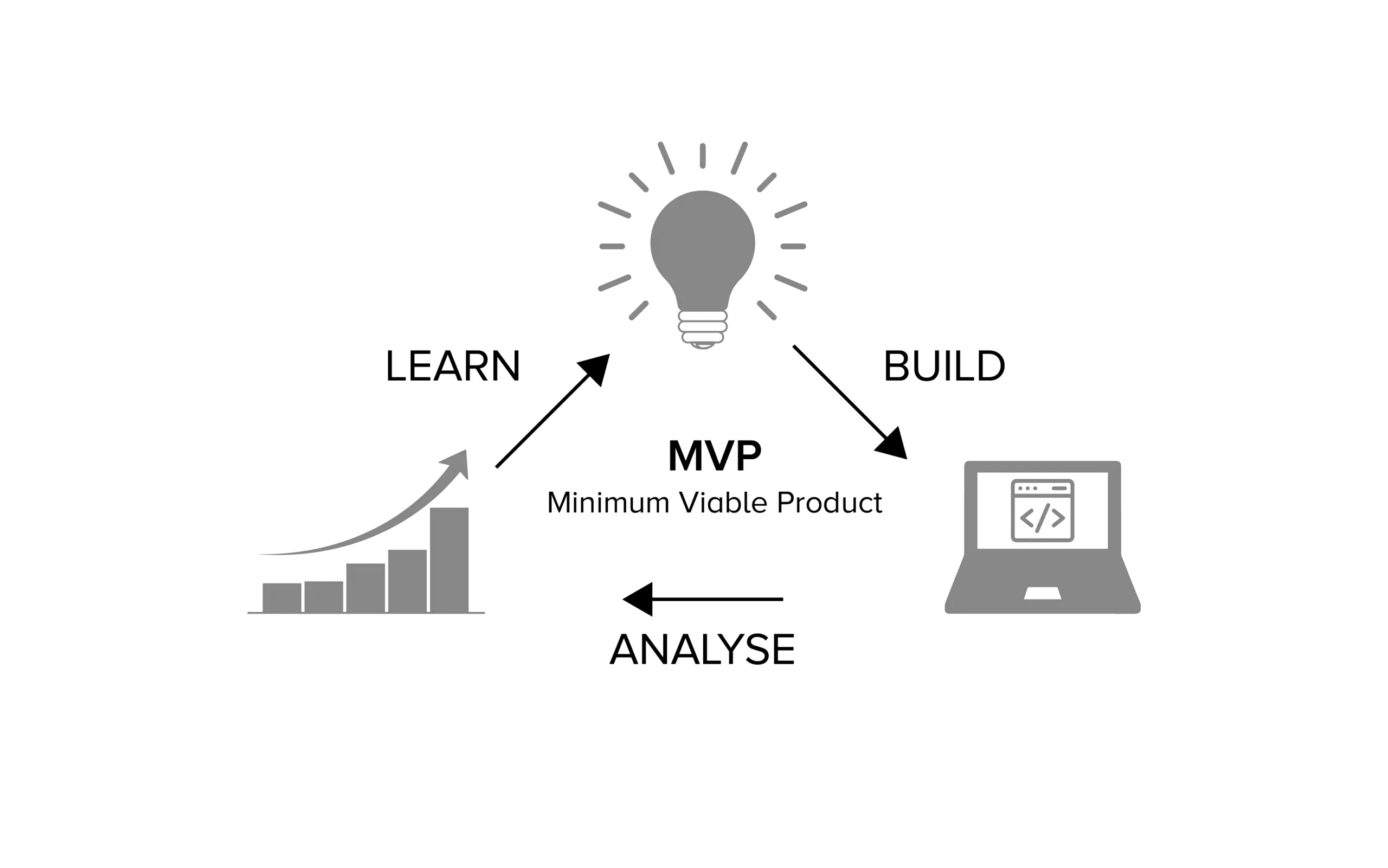
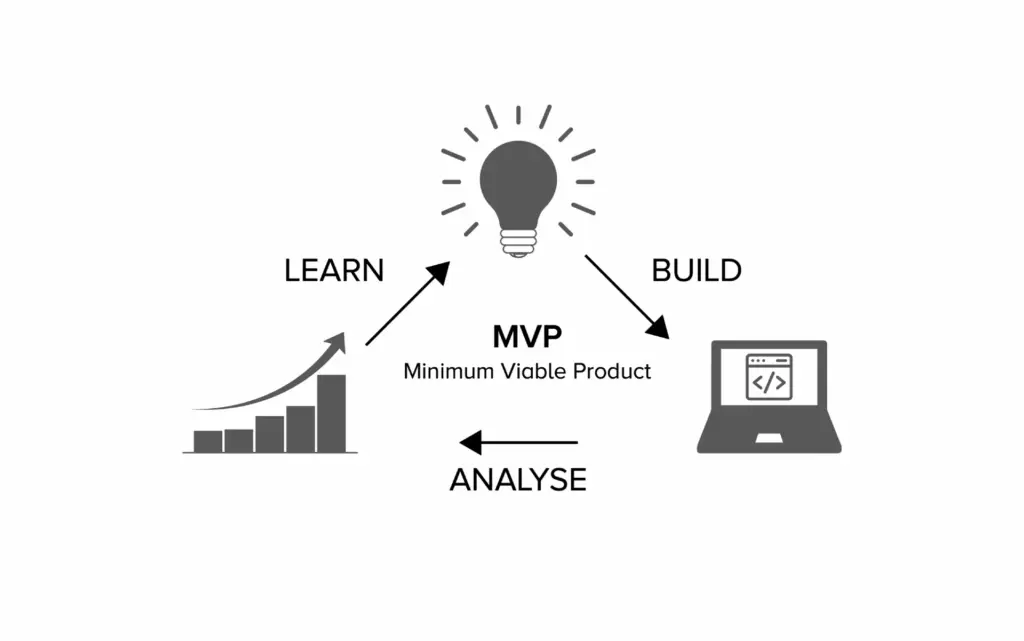
Eric Ries described the core engine of Lean Startup thinking as the Build-Measure-Learn loop:
- Build the smallest experiment that can test your core assumption.
- Measure what users actually do, using pre-defined metrics.
- Learn from the data, and decide whether to pivot, persevere, or stop.
Then repeat.
This loop never really ends. Even after your MVP grows into a full product, smart product teams keep running smaller versions of this loop on individual features, pricing changes, and new user segments.
The MVP is also not a one-time event. It is a way of thinking about every decision you make as a product team. Before adding any new feature, ask: what is the simplest version of this we could test first?
The best product teams in the world did not get it right on the first try. They shipped early, listened hard, and kept improving based on what real users showed them. That is what an MVP is for.