How to Develop an MVP

From raw idea to your first real users — without building the wrong thing.

The Minimum Viable Product process addresses this challenge directly. It is not a shortcut or a compromise; rather, it is a rational approach to building new products in uncertain environments. The MVP framework prioritizes testing your riskiest assumptions early, before you exhaust your resources, your team’s energy, or your users’ goodwill.

This guide leads founders, product managers, and builders through each stage of MVP development, from validating the problem to determining when to stop iterating and begin scaling.

"Most startups don't fail because the product was built badly — they fail because the wrong product was built entirely."

90%

of startups fail
 

42%

built something no one needed

3–6 mo

average MVP timeline

$0

needed to validate

What is an MVP? and what it's not
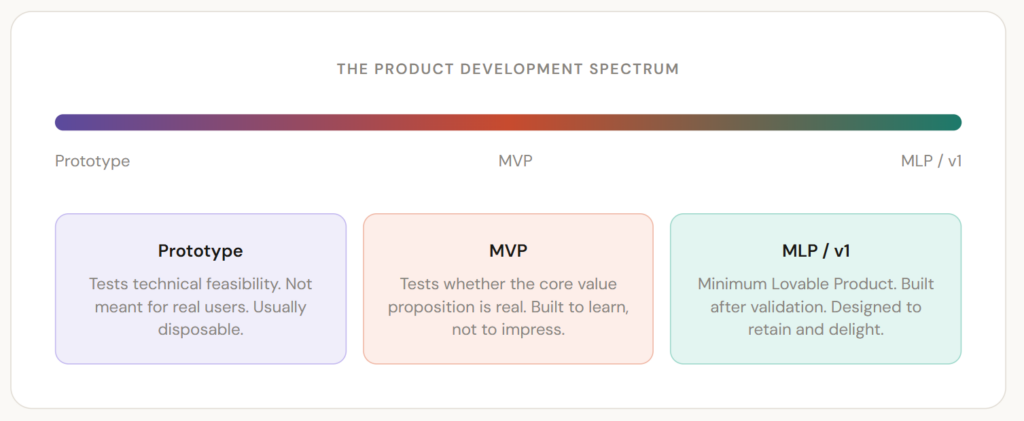
Eric Ries, who coined the term in The Lean Startup, defined an MVP as “that version of a new product which allows a team to collect the maximum amount of validated learning about customers with the least effort.”
 
The keyword there is learning, not shipping.
 
Before we continue, let’s address three common misconceptions that often undermine MVPs from the outset.
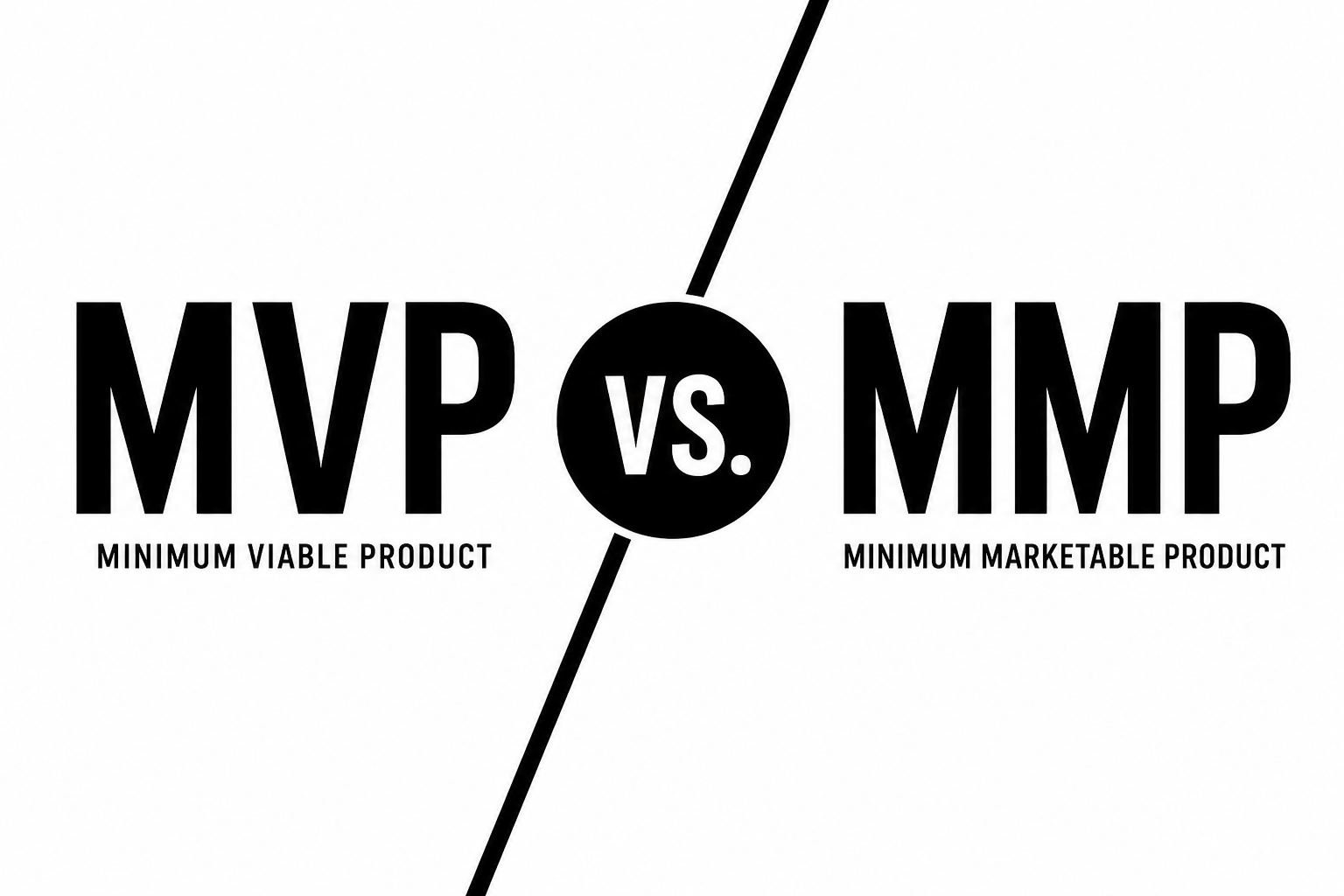
The Product Development Spectrum

The three myths you need to kill right now

Myth 1: An MVP is a poor-quality version of your product. This is incorrect.

An MVP is designed to be the appropriate size for the specific question you need to answer. It could be a brief landing page, a recorded demonstration, or a manual process. Minimal does not mean low quality.
 

Myth 2: An MVP is the same as a beta.

In reality, a beta is a technical testing phase for a product you have already committed to building. An MVP is a tool for learning, which may indicate that you should not proceed with development.
 

Myth 3: An MVP must be software.

For example, Dropbox validated demand without writing any product code. They released a three-minute demonstration video, which resulted in 70,000 signups overnight. In this case, the MVP was the video.

Dropbox — a demo video, not code. Airbnb — three airbeds in a San Francisco apartment. Zappos — a founder buying shoes from other stores and manually shipping them. All became billion-dollar companies. None built software first.

Validate the problem before touching a keyboard

The most expensive mistake in product development is building a solution before confirming the problem is real. Most founders skip this step because it feels uncomfortable. Talking to potential users seems slow, while building feels productive. This is a trap.

42%

of failed startups cite “no market need” as their primary reason for failure.
CBInsights Startup Failure Report
 

5–25×

cheaper to acquire a customer if you get product-market fit right from the start
Harvard Business Review

100

conversations is the minimum before you should trust a pattern you think you’re seeing
Rob Fitzpatrick, The Mom Test

3

signals that a problem is real: frequency, intensity, and money already spent on workarounds
YCombinator framework

How to run a problem interview?

The goal of a problem interview is not to pitch your idea. It is to understand the world as the potential user experiences it. Rob Fitzpatrick’s “Mom Test” is the best framework for this: ask questions even your mom cannot lie about because they focus on facts, not opinions.

The Problem Interview Checklist

Red flag vs green flag

Red flag: "Yeah, that would be nice to have." Green flag: "Oh my god, we've been trying to solve this for months. Where do I sign up?" The energy matters as much as the words.

Define your target user with ruthless precision

“Anyone who has this problem” is not a user segment. It’s a way of avoiding the hard work of defining who you’re really building for. The narrower your early target, the faster you’ll learn, and the more likely your product will be exactly right for someone instead of vaguely okay for everyone.

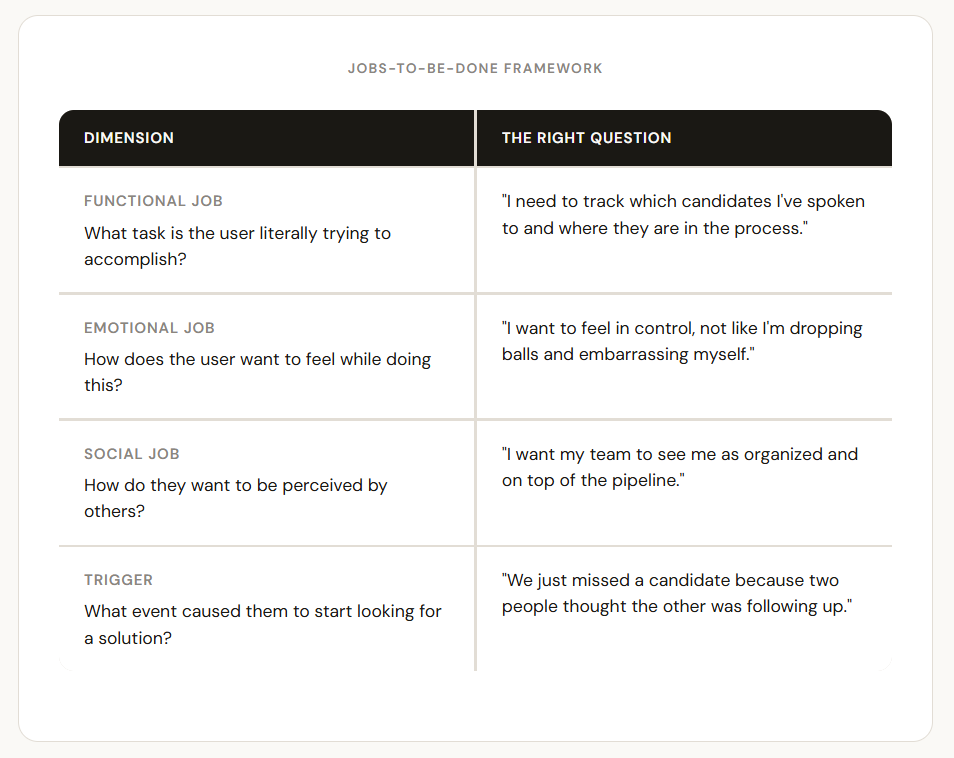
Jobs-to-be-Done Framework

Jobs to be Done Framework

The three layers of narrowing

Begin with a broad segment and refine it through three levels of specificity. For example: Small business owners, then solo service business owners who invoice clients, and finally freelance designers who invoice more than ten clients per month and currently use spreadsheets.

This third-level persona has specific needs, context, and behaviors. You can identify, engage, and develop solutions tailored to them. Products that address these needs effectively often become category leaders, as these users become strong advocates.

Scope your MVP: what to build and what to ruthlessly cut

This is where most MVPs go wrong. Not in the building — in the scoping. Feature lists grow because saying no is hard, because stakeholders have opinions, because you’re excited. The antidote is a simple filter: does this feature directly serve the one hypothesis you’re testing? If not, it’s a future version’s problem.


"If you're not embarrassed by the first version of your product, you've launched too late."

Three prioritization frameworks — pick one

MoSCoW Method

 
Categorize features as Must-have, Should-have, Could-have, Won’t-have. MVP = Must-haves only.
 
Best for: Early-stage teams with diverse stakeholders

RICE Scoring

Score each feature on Reach, Impact, Confidence, Effort. Rank by score. Cut everything below your threshold.
 
Best for: Data-driven teams with existing signal
 

Impact vs. Effort Matrix

Plot features on a 2×2. Build high-impact, low-effort features first. Defer the rest.
 
Best for: Visual thinkers and cross-functional workshops
 

The One Sentence Test

Write your value prop in one sentence. Every feature that doesn’t directly enable it gets cut.
 
Best for: Solo founders or early co-founder teams

Before building anything, simulate your product manually. Charge real money. Deliver the outcome by hand. If customers pay and come back, then you build software to automate it. This approach eliminates the biggest risk in one step.

Choose your MVP type and build strategy
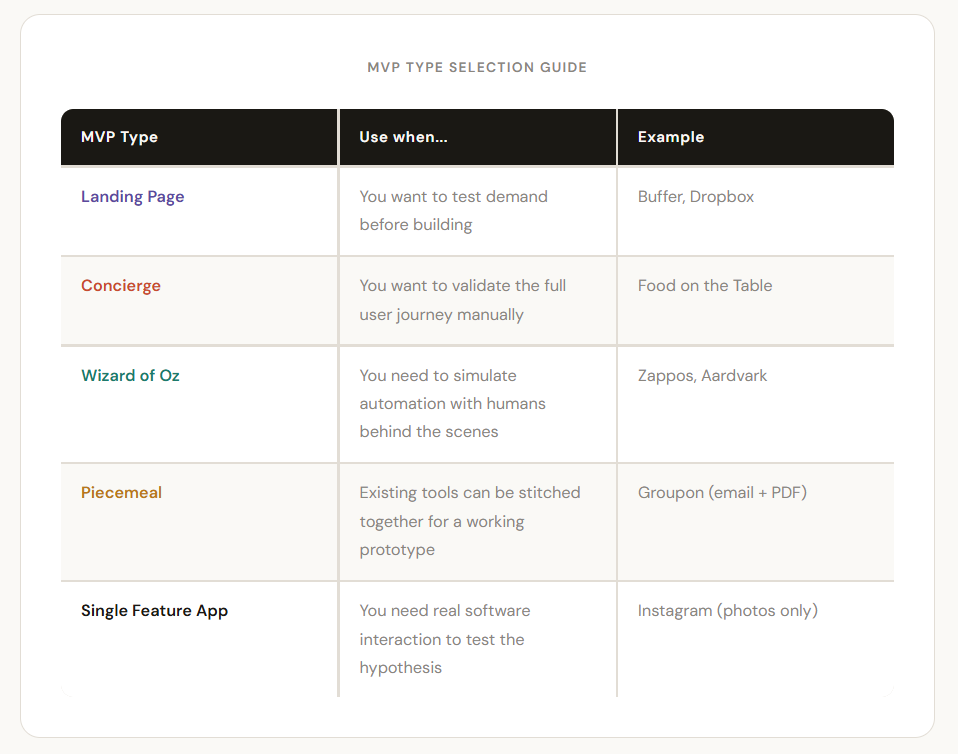
Not all MVPs are apps. The right MVP type depends entirely on what question you’re trying to answer. Matching the format to the hypothesis is one of the highest-leverage decisions you’ll make.

MVP Type Selection Guide

Build vs. no-code vs. low-code

Unless your product’s core value proposition is a technical innovation that can only be demonstrated with custom code, resist the urge to engineer from scratch. Tools like Bubble, Webflow, Glide, and Airtable can produce functional MVPs in days, not months. Save engineering velocity for after you have signal.

On technical debt at the MVP stage

Taking shortcuts is acceptable — even advisable — at the MVP stage. What matters is knowing which shortcuts you’re taking. Acceptable: manual processes, hardcoded values, no caching, limited error handling. Unacceptable: insecure data handling, architectural decisions that will require a full rewrite at 10× scale.

Get your first users — without a marketing budget

Paul Graham’s directive — “do things that don’t scale” — is the most important piece of early-stage distribution advice ever written. Your first 100 users should not come from ads, SEO, or a viral loop. They should come from you, personally, reaching out to people who have the problem you’re solving.

1. Start with your warm network

Who do you personally know who has this problem? Message them directly. Not a mass email — a personal message that shows you’ve thought about their specific situation.

2. Find communities where your user lives

Reddit threads, Slack workspaces, LinkedIn groups, niche forums. Be genuinely helpful for weeks before you mention your product. Earn the right to pitch.

3. Cold outreach with radical personalization

One message that proves you’ve read their LinkedIn, blog, or tweets will outperform 500 generic emails. Reference something specific. Offer something specific.

4. Launch on Product Hunt and Hacker News

A “Show HN” or PH launch gives you concentrated early-adopter traffic. These users are tolerant of rough edges and great at feedback — ideal for an MVP.

5. Charge from day one

Free users will tell you what they want to be true. Paying users will tell you what’s actually true. Even $10/month filters out tire-kickers and produces dramatically better signal.

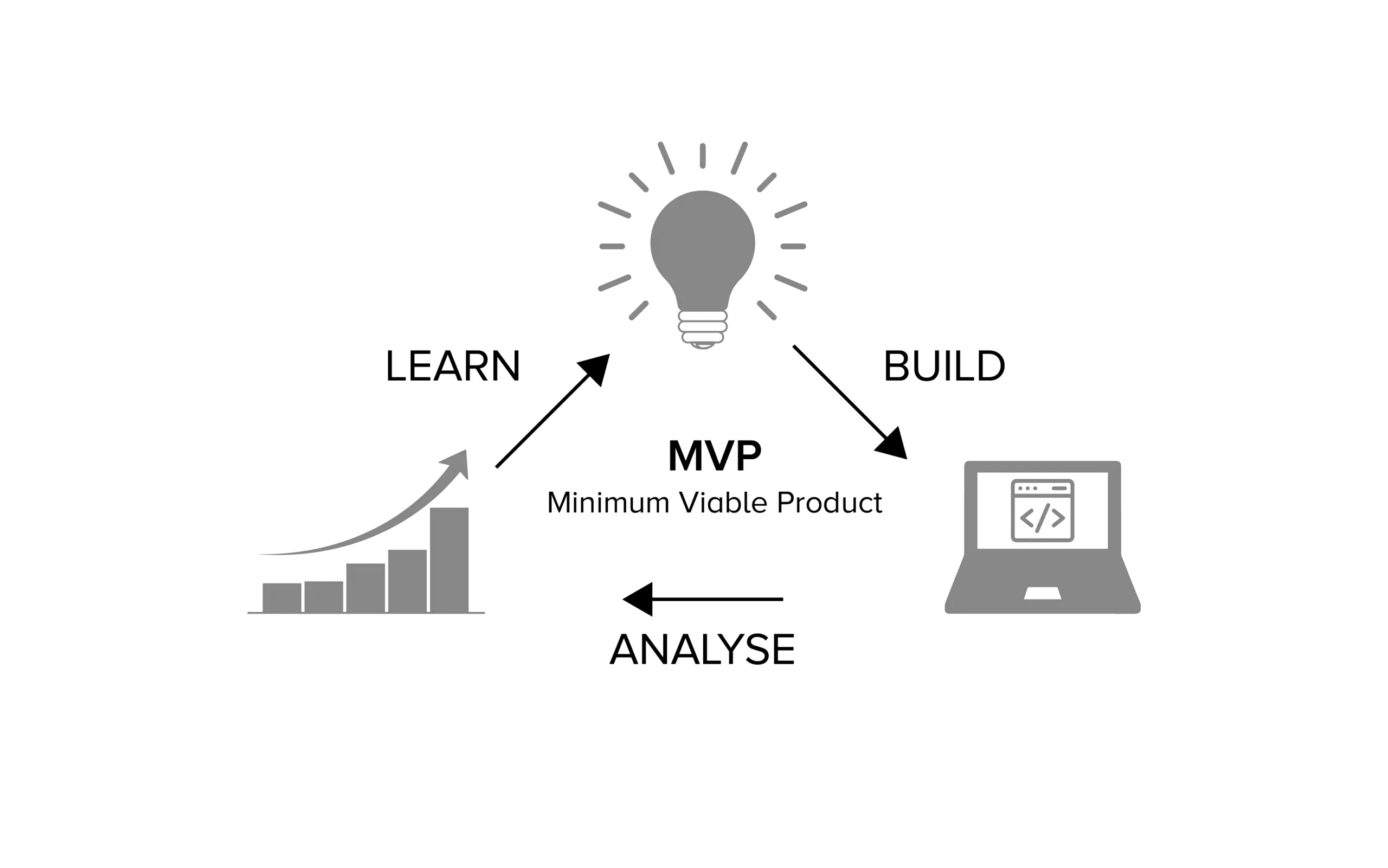
Measure, learn, and decide: the build-measure-learn loop
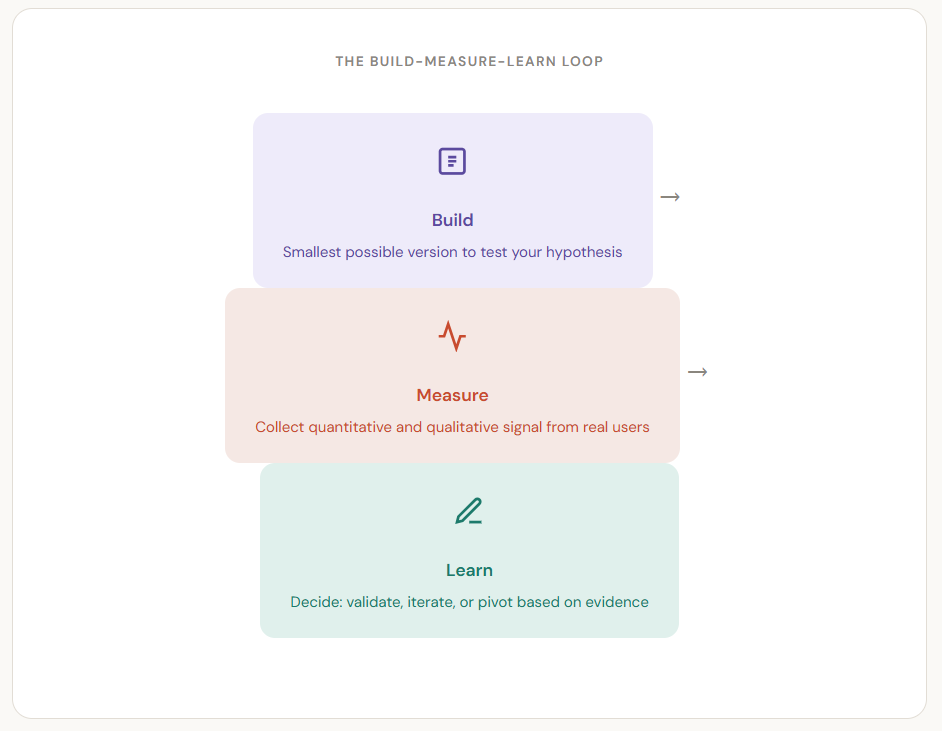
Shipping your MVP marks the beginning, not the end, of the process. Meaningful progress starts once you have users and data. The build-measure-learn loop drives the MVP process, and the value of your insights depends on how effectively you establish measurement before launch.
The Build-Measure-Learn Loop mvp

The metrics that actually matter at the MVP stage
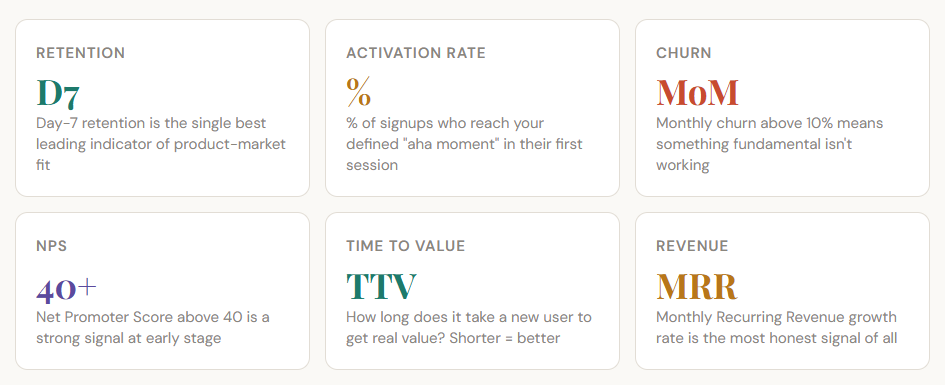
The metrics that actually matter at the MVP stage

The pivot vs. persevere decision

Signals to persevere

  • Users are coming back even when the product is rough
  • Some users describe it as “irreplaceable”
  • Activation is improving week-over-week
  • Word-of-mouth is bringing in users you didn’t reach out to
  • Users are angry when the product breaks — not indifferent

Signals to pivot

  • Users sign up, try it once, and disappear
  • NPS is below 20 and not improving
  • You have to convince every single user it’s worth using
  • User interviews reveal a different problem they care more about
  • No one is willing to pay, even at a very low price

From MVP to v1: when and how to scale

There isn’t one clear metric that shows your MVP is finished and version one is ready. Instead, you’ll notice a mix of signals, and it takes real honesty to see what’s actually happening instead of just what you hope to see.

Signs your MVP has proven its thesis

What changes between MVP and v1

The MVP proved the hypothesis. V1 is about making the product reliable, onboardable, and polished enough to grow. The order of operations matters enormously:

1. Stability first

 
Bugs, crashes, and data loss will kill growth faster than any missing feature. Fix these before anything else.
 

2. Onboarding second

 
If you’ve been hand-holding every user through setup, now you need to encode that into the product itself. Time-to-value should drop dramatically.
 

3. Polish third

 
Empty states, error messages, loading indicators, mobile responsiveness. These details signal professionalism and build trust at scale.
 

4. New features last

 
Don’t add new capabilities until the core is solid. New features on an unstable foundation make everything worse.
 

The MVP mindset never fully ends


The best product teams at companies like Stripe, Notion, and Linear never fully abandon MVP thinking. They continue shipping small, learning fast, and killing features that don’t pull their weight. The MVP is not a phase — it’s a culture.


Add comment:

Related Articles

Recent Posts

Ads banner (320 X 320)

Cart (0 items)
Close

Our approach is straightforward— prioritizing functionality, speed, and clarity for solutions.

WANT IT TO SOUND PLAYFUL, LUXURIOUS, OR MORE/
Select the fields to be shown. Others will be hidden. Drag and drop to rearrange the order.
  • Image
  • SKU
  • Rating
  • Price
  • Stock
  • Availability
  • Add to cart
  • Description
  • Content
  • Weight
  • Dimensions
  • Additional information
Click outside to hide the comparison bar
Compare