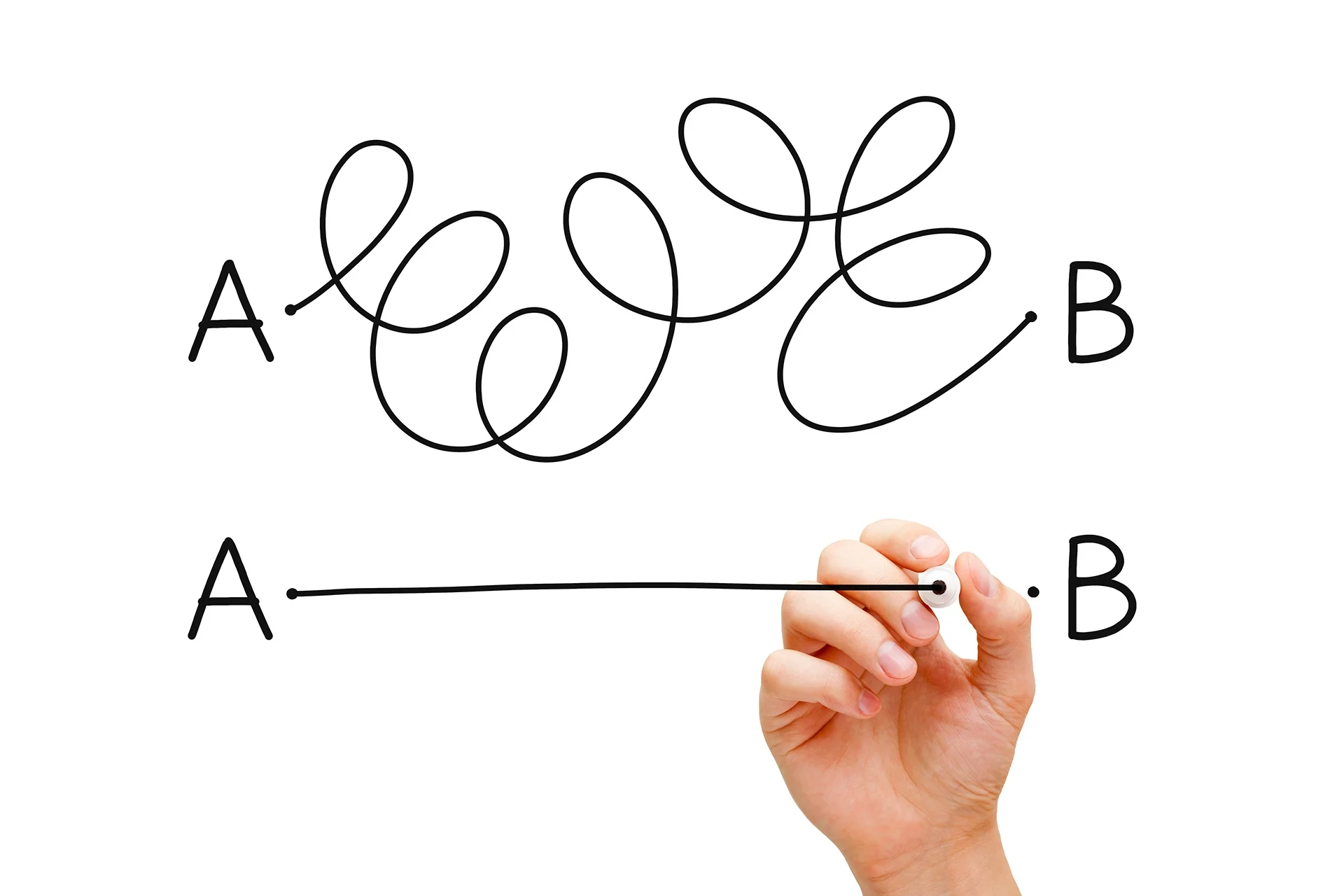


In business terms, a minimum viable product is the smallest version of your idea that a real customer will actually buy or use, built to test a specific business hypothesis before you spend real money finding out you’re wrong. That’s the plain-language definition, and the most common mistake founders make is treating it as a cheap, low-quality draft instead of a strategic test.
Building one is a real commitment: a set budget, a fixed timeline, and a narrower feature set than the team wanted. That’s different from a prototype or a proof of concept, both of which test feasibility internally, not whether a real customer will pay.
Investors expect founders to talk in terms of validated learning, not features, and a business needs a plan for what happens if the idea doesn’t validate: pivot, or stop, not rebuild the same thing with more features. Product, engineering, sales, marketing, and finance all deserve a seat at that table, though the founder makes the final call.
The word “MVP” causes friction because it means something different to every department, and a non-technical founder is better off describing the business outcome needed than trying to sound technical. Carry the same definition this guide opened with into your next meeting: the smallest thing a real customer will use, built to test one assumption before the business bets more.
What Is an MVP in Simple Business Terms?
MVP stands for minimum viable product: the simplest version of a product a business releases to test whether real customers actually want it. It’s not the final product, and it isn’t a rough sketch either.
It’s a working version built around one core function, released to validate a business idea before spending more money, time, and resources. If it doesn’t answer that one question honestly, it isn’t doing its job.
What Does ‘MVP’ Actually Mean When Your Team Says It?
When someone says “MVP” in a meeting, they mean the smallest version of your product a real customer will use or pay for, built to test one assumption about your business model. That’s the plain-language definition, and it has nothing to do with code quality or feature count.
Engineers often mean something narrower: the technical scope needed to ship a working build. Marketing might mean whatever gets shown to the first customer base. Finance hears “budget line.” None of these are wrong — they’re just answering different questions.
The rest of this guide translates that gap into concrete business terms: what building one commits you to, how to talk about it with investors, and who owns the decision.
What’s the Biggest Misunderstanding Founders Have About MVP?
The biggest misunderstanding is treating a minimum viable product as a cheap, low-quality draft instead of a strategic test. “Minimum” describes scope, not craftsmanship, and founders who miss that distinction make one of two costly mistakes.
Some under-scope: they ship something so thin it can’t validate anything, lacking enough features for a real customer to complete the one job the product exists to prove. Others over-scope, building a near-complete product before anyone’s confirmed the idea is worth building.
Fixing this starts with a clear grip on what a minimum viable product is, and it prevents most of the budget and timeline surprises covered later in this guide.
What Business Terms Get Confused With MVP Most Often?
Founders often use “MVP,” “prototype,” “beta,” “demo,” and “pilot” interchangeably in meetings, and that habit causes real budget and scope confusion. Each term implies a different product or service commitment, and mixing them up creates mismatched expectations before you build a feature.
- Prototype: rough models to test how something looks or works, thrown away afterward.
- Demo: scripted walkthroughs to show an idea, not built for a real user persona to use.
- Pilot: limited real-world tests with an actual customer, often run after the MVP stage.
- Beta: more complete products tested by a wider group to catch bugs, not test the core idea.
- MVP: the smallest real version, built around a documented action plan to test one business assumption.
Naming the difference out loud prevents most downstream confusion.
MVP vs Prototype vs Proof of Concept vs Beta
An MVP is the only one of these four built specifically to test real customer demand with real users, not just internal feasibility or design. Prototypes, proof-of-concept builds, and betas each test something different.
| Product Type | Main Purpose | Real Users? | Business Validation? |
| Prototype | Tests design and concept | Usually no | No |
| Proof of Concept | Tests technical possibility | No | No |
| MVP | Tests customer demand | Yes | Yes |
| Beta | Improves an existing product | Yes | Limited |
Founders sometimes shortcut this table by calling any early build an “MVP.” That’s the mistake worth avoiding: only a build tested with real customers, aimed at answering a real business question, earns the name.
Why Do Businesses Build an MVP Before Full Product Development?
Businesses build an MVP before full product development because it’s the fastest, cheapest way to see whether an idea deserves a bigger investment. Four business reasons drive that decision.
Validate Customer Demand Early
An MVP tells a business whether real customers actually want the product, before a single dollar goes into a full build. Interest in a pitch deck or a survey isn’t the same as someone using or paying for a working version. Real usage is the only signal that reliably predicts real demand.
Reduce Business Risk
Testing early protects a business from spending its full budget on an idea that might not work. CB Insights’ analysis of startup post-mortems found that poor product-market fit is cited in 43% of failed startups, more than any other single reason. An MVP catches that risk early, while it’s still cheap to fix.
Save Development Time and Resources
Building only the features needed to test the idea lets a business move faster than building everything at once. Every extra feature adds design time, development time, and QA time, none of which help answer the one question an MVP is meant to answer. Cutting the list down is what keeps the timeline short.
Collect Real Customer Feedback
Real customer feedback from an MVP shows a business what to build next, not what the team assumes customers want. That feedback becomes input for every product decision that follows, including which features to add and which to drop.
How Does the MVP Development Process Work?
Building an MVP follows six steps, from identifying the problem to deciding what happens next. Skipping any of them is usually where the process breaks down.
Step 1: Identify the Customer Problem
Every MVP starts with a real, specific customer problem, not a feature idea. Before building anything, the team needs to know exactly who has the problem and how they deal with it today, without the product.
Step 2: Define Your Business Hypothesis
A business hypothesis states exactly what the team believes will happen and why, in one testable sentence. For example: “We believe customers will pay for an online appointment booking solution because it saves them time.” Everything the MVP tests should trace back to that one sentence.
Step 3: Choose Only Essential Features
Choosing only essential features means separating what proves the hypothesis from what’s just nice to have. A simple prioritization framework like MoSCoW sorts features into must-have, should-have, could-have, and won’t-have-yet, keeping the decision honest instead of emotional.
Step 4: Build and Launch the MVP
Building and launching an MVP means creating a simple, working version and putting it in front of real users, not perfecting it in isolation. The build only needs to work reliably for the one job it’s meant to prove, nothing more.
Step 5: Measure Customer Response
Measuring customer response means tracking a specific set of numbers, not just watching to see what feels like it’s working. The metrics that matter most: user engagement, sign-ups, conversion rate, customer feedback, and revenue.
Step 6: Decide Whether to Improve, Pivot, or Stop
The results from step five decide what happens next: improve the current direction, pivot to a different one, or stop before spending more. That decision should follow the evidence, not how much the team has already invested.
What Features Should Be Included in an MVP?
A good MVP includes exactly five things: a core problem-solving feature, a basic user experience, an essential customer journey, a feedback collection method, and analytics tracking. Nothing else belongs in version one.
- Core problem-solving feature: the one function that actually solves the customer’s problem, built to work reliably.
- Basic user experience: simple, usable design, not a polished final interface.
- Essential customer journey: the shortest path a user needs to complete the core action, start to finish.
- Feedback collection method: some direct way to hear from users, like a short survey or an email link.
- Analytics tracking: basic instrumentation to measure what users actually do, not just what they say.
What to leave out matters just as much: too many features, complex design elements, advanced automation, and any feature that doesn’t help validate the idea. If a feature doesn’t touch one of the five essentials above, it belongs on the version-two list.
What Does Building an MVP Actually Commit Your Business To?
Building a minimum viable product is a real commitment of budget, team time, and scope, not a free trial you can walk away from painlessly. Once you start, three things are locked in that matter to the business, not just the build team.
The first is a fixed initial budget: real money against a defined scope. The second is a timeline: weeks focused on this instead of other business objectives. The third is a narrowed feature set: the smallest version of the idea, not the wish list.
Committing to a launch date without agreeing on all three first is where most first-time founders get burned. The next two sections break down the budget and timeline commitments.
How Much of Your Budget Should an MVP Consume?
Most first-time MVPs should consume roughly 20 to 30% of total early-stage runway, leaving enough capital for hiring and go-to-market after launch. Spending much more on a first build is the single most common early-stage mistake, because it leaves nothing for the pivot most ideas need once real feedback comes in.
Founders chase completeness instead of financial viability, pouring the entire budget into development before anyone outside the team has used the product. That’s backwards: the goal is spending the least amount necessary to get an honest answer.
Full cost breakdowns, with real dollar ranges by build complexity, live in the dedicated MVP cost plan elsewhere on the site.
How Long Should Your Team Expect to Be in MVP Mode?
Most businesses should expect to be in MVP mode for two to four months, from kickoff to a clear go/no-go decision. That covers roughly six to twelve weeks of build time plus a few weeks to test the product with real users.
“Done” doesn’t mean feature-complete. In the minimum viable phase, done means the team has enough evidence — real usage, real feedback, real willingness to pay — to make a confident call.
The most common trap is treating MVP as a permanent phase instead of a fixed decision window. If your team is still calling something an early MVP a year later, nobody made the call.
Want a Team That Speaks Both Business and Technical Language?
MVPfy translates what MVP means for your business into an actual build plan, in business language, before any technical work starts. That’s the gap this guide describes: founders understand budget and market risk, dev teams understand architecture, and the two sides rarely speak the same language without help.
MVPfy scopes your MVP budget and timeline in plain business terms first, then hands the build team a scope that’s already translated. That means no surprise technical detour three weeks into the build, whether your company has built five MVPs before or none.
The next step is simple: book a free MVP scoping call and get a business-language breakdown of your specific idea before you commit a dollar.
Is an MVP the Same Thing as a Prototype?
No. In business terms, an MVP is a scoped investment meant to ship and validate real demand, while a prototype only tests feasibility internally, with no paying customer involved. The budget implication follows directly.
A prototype is typically a smaller, throwaway spend: money to answer “can we build this,” set aside once the answer’s clear. An MVP is money spent to answer a bigger question: whether a real customer will actually use or buy this new product, with the features that will ship in version one.
This page covers the business side of that decision. Founders who also want the technical side—architecture, integrations, and build effort, not just budget—can read the full MVPMVP vs. prototype comparison guide.
Is an MVP the Same Thing as a Proof of Concept?
No. The core question of an MVP is whether real customers will actually use or pay for the idea, while a proof of concept only answers whether it can be built. Confusing the two costs money in both directions.
Teams that treat a proof of concept like an MVP over-invest in a technical exercise nobody outside engineering ever sees. Teams that treat an MVP like a proof of concept under-invest, shipping something too rough for a real customer to judge fairly.
This page covers why the two answer different business questions. Teams weighing a proof of concept first can get the deeper technical comparison in the dedicated MVP vs proof of concept guide.
Real-World MVP Examples From Successful Companies
Three well-known companies show how a limited first version can prove an idea before a business scales it.
Airbnb MVP Example
Airbnb tested demand with nothing more than a simple website before building a platform. In 2007, founders Brian Chesky and Joe Gebbia rented air mattresses in their own apartment and built a basic site to see whether strangers would actually book a stay in someone’s home. They would.
Dropbox MVP Example
Dropbox validated demand with a short demonstration video, not a working product. Instead of building the file-sync technology first, the company posted a simple explainer video showing how the product would work. The waitlist signups that followed proved the demand before a single feature shipped.
Uber MVP Example
Uber started with a limited, manual-feeling version tested on a small group of users in one city before expanding anywhere else. The earliest version, launched in San Francisco as UberCab, offered only black cars, booked through an iPhone app or text message. Only after that limited test proved people would pay for the convenience did the company expand into new cities and vehicle types.
How Do You Explain MVP to Investors Without Sounding Unprepared?
Investors expect founders to talk about MVP in terms of validated learning and milestones, not a feature list. Describing screens and buttons instead of what you tested reads as unprepared, even when the build itself was solid.
One structure covers almost every investor question: what you’re testing, how you’ll measure it with real user feedback, and what you’ll do with the result either way. That works whether you’re pitching product strategy or product marketing, because investors are really asking whether you know how to learn quickly with limited capital.
The next section breaks down the specific questions a team should be ready to answer.
What Questions Should Your Team Be Ready to Answer?
Every investor or board member will ask three questions: what you’re testing, how you’ll know it worked, and what’s next either way. Rehearsing clear answers before any pitch prevents the most common stumble in the room.
“We’re not sure yet” is acceptable only for the third question. Founders who can’t state what they’re testing or how they’ll measure a real user’s response haven’t built a viable product test — they’ve built something and hoped.
Walk through the pros and cons of your specific test out loud with your team before the pitch, not during it.
What Red Flags Suggest Your Team Doesn’t Understand MVP?
If your team is debating font choices before defining what you’re testing, your MVP conversation has gone off track. Watch for these red flags before committing budget to a launch.
- No one can state the hypothesis. If nobody can finish “we believe X will happen because Y,” you’re not ready to scope anything yet.
- The feature list keeps growing. Every meeting adds one more “must-have” instead of cutting toward the smallest testable version.
- Success isn’t defined. Nobody’s agreed on what result counts as a validated product idea versus a failed one.
- Departments are guessing differently. Marketing, sales, and product each build toward a different picture of “done” for this small business.
Any one of these, left unresolved, usually shows up later as a blown budget or a missed launch date.
How Do You Measure MVP Success?
An MVP’s success is measured across five signals, not a single number.
Customer Adoption
Customer adoption measures how many people actually try the product, out of everyone who could. High adoption means the offer and audience are aligned.
User Engagement
User engagement measures how often people come back and use the product after the first try. One-time use without a return visit is a warning sign, not a win.
Conversion Rate
Conversion rate measures how many users complete the specific action the business needs them to take. That’s signing up, booking, or buying, depending on what the MVP is testing.
Customer Feedback
Customer feedback shows whether users find the product genuinely valuable, not just usable. Usable and valuable aren’t the same thing, and only one of them predicts whether someone sticks around.
Willingness to Pay
Willingness to pay is the strongest signal of all: whether customers are ready to spend real money on the product. Compliments cost nothing. Payment costs something, which is exactly why it matters more.
An MVP is successful when it provides enough evidence to make a confident business decision.
Common MVP Mistakes Founders Should Avoid
Five mistakes account for most MVP failures, and none of them have to do with the underlying idea.
Building Too Many Features
Building too many features increases cost and delays the one thing an MVP is supposed to do: validate the idea quickly. Every additional feature is time spent not answering the core question.
Trying to Make the MVP Perfect
Trying to make the MVP perfect misses the point: an MVP exists to learn, not to be a finished product. Polish comes later, once the idea’s proven worth polishing.
Ignoring Customer Feedback
Ignoring customer feedback wastes the one advantage an MVP gives a business: real information from real users. Feedback should guide every improvement, even when it contradicts the original plan.
Launching Without a Clear Goal
Launching without a clear goal makes it impossible to know afterward whether the MVP actually worked. Every MVP needs a specific business hypothesis defined before launch, not a general sense that “we’ll learn something.”
Measuring the Wrong Metrics
Measuring the wrong metrics, like downloads or pageviews, creates a false sense of progress. Vanity metrics look encouraging on a slide, but they don’t show whether the business idea is actually working.
What Happens After an MVP Launch?
What happens after an MVP launch depends entirely on the result: succeed, and the business scales; fail, and it adjusts.
If the MVP Succeeds
A successful MVP gives a business the evidence to invest further, not proof that the work is finished. The natural next steps:
- Improve the product based on what real usage showed.
- Add the features users actually asked for.
- Scale marketing to reach more of the validated audience.
- Increase customer acquisition with proven messaging.
If the MVP Fails
A failed MVP still gives a business something valuable: a clear, cheap answer before a bigger investment. The next moves:
- Analyze the customer feedback that came in.
- Identify what specifically didn’t work.
- Pivot the idea toward what the evidence supports.
- Stop entirely if the market doesn’t support the product.
What Happens to the Business If the MVP Fails to Validate?
Failing to validate is a successful outcome of the MVP process, not a business failure, as long as the learning is real. The point of testing a business hypothesis early is finding out cheaply, before a larger product development budget is on the line.
Two legitimate paths follow a genuine no from the market: pivot the idea toward what the evidence supports, or stop and protect the remaining runway. Both beat the alternative.
The one real mistake is ignoring a clear no and rebuilding the same idea with more features, hoping volume fixes what positioning or demand couldn’t.
How Do You Know an MVP Genuinely Failed to Validate?
Genuine invalidation looks like this: no one uses the product without being reminded to, and no one will pay for it, even after real market exposure. That’s different from a fixable execution problem, and founders often blame the market when the real issue was scope, pricing, or positioning.
Before declaring the business hypothesis dead, ask one gut-check question: did people matching your target customer actually try the core action, or did the test never reach the right audience?
If the feedback shows real people tried it and still said no, that’s validation working as intended.
Which Departments Should Be Involved When You Build an MVP?
An MVP touches more of the company than just engineering, and here’s who else should have a seat at the table. Leaving any of these out usually shows up later as a scope or budget surprise.
- Product: owns the hypothesis and what “validated” means.
- Engineering: owns feasibility and the realistic timeline.
- Sales or customer success: knows what current customers already ask for and would pay for.
- Marketing: shapes how the test reaches real people, not just build quality.
- Finance: confirms the budget is real and tied to actual runway, not a guess.
None of these departments should run the build. They should each have input before scope gets locked.
Who Should Make the Final Call on Your MVP Scope?
The founder makes the final scope call, informed by input from product, engineering, and whoever owns the budget. That’s true even when you outsource the build.
Scope-by-committee is the fastest way to blow an MVP’s budget and timeline, because every department has a reason to want more in version one. Founders who let that happen usually ship something too broad to test cleanly.
When technical input and business judgment disagree, weigh them by what protects the test: does the disputed feature help gather real user feedback, or make the product look more finished?
Why Does the Word ‘MVP’ Cause So Much Team Friction?
“MVP” causes friction because it implies a different scope, budget, and timeline to each department using it. Engineering hears a technical build target. Marketing hears a launch date. Finance hears a budget line. Nobody’s wrong — they’re just talking about different things.
The fix is straightforward: agree on the specific business definition, from earlier in this guide, before scoping any features. That single alignment step, borrowed from the lean startup discipline this approach descends from, prevents most of the friction this guide covers.
Skipping it doesn’t save time. It just moves the disagreement later, when it’s more expensive to resolve.
How Should a Non-Technical Founder Talk to Developers About MVP?
A non-technical founder builds more trust by describing the needed business outcome, not the features wanted, and letting the development team translate that into a build. That one framing shift improves most conversations between founders and technical teams.
Saying “I need to know if people will pay for this idea” gives a developer something to design around. Saying “I need a login page, a dashboard, and three integrations” skips straight to a guess at implementation.
Leading with business language earns more trust with a technical team than trying to sound technical, because it shows you’re thinking about what actually makes this a viable product.
Frequently Asked Questions About MVP
These are the questions founders ask most often about what MVP means for their business.
What Does MVP Stand For in Business?
MVP stands for minimum viable product: the smallest version of a product built to test real customer demand.
Is an MVP a Finished Product?
No, an MVP is not a finished product. It’s a working test built around one core function, meant to prove or disprove a business hypothesis.
How Long Does It Take to Build an MVP?
Most MVPs take two to four months from kickoff to a clear go/no-go decision, including build time and testing.
How Much Does an MVP Cost?
MVP costs vary by scope and complexity, and most first-time MVPs should stay within roughly 20 to 30% of total early-stage runway.
Can an MVP Fail?
Yes, and a failed MVP that produces honest evidence is a successful outcome of the process, not a business failure.
What Happens After an MVP Succeeds?
After an MVP succeeds, a business typically improves the product, adds validated features, and scales marketing and customer acquisition.
Who Decides the MVP Scope?
The founder decides the MVP scope, informed by input from product, engineering, and whoever owns the budget.
What Should You Remember About MVP’s Meaning in Business?
Before your next meeting, here’s the one-sentence business definition and the budget-and-timeline commitment to carry with you, the same one this guide opened with. Minimum viable product means the smallest version of your idea a real customer will use or pay for, built to test one business assumption before you spend more.
- It’s a real commitment: fixed budget, fixed timeline, narrowed features.
- Failing to validate is a successful outcome if the learning is real.
- The founder makes the final scope call, not committee consensus.
- Every department should agree on this definition before scoping a feature.
Carry that plan into the next meeting, and most of the friction this guide covers never starts.